5 November 2026
From the Vineyard
The Blog.
5 November 2026
Keeping the young vines alive!
The hot summer tested both the vines and our commitment to keeping them alive. With 1,200 newly planted vines in the ground and no irrigation system in place, watering became the single most important task in the vineyard.
Whenever we were able to visit the site, watering took priority over everything else, even jobs such as strimming around the vines. In truth, nature eventually took care of some of that problem for us, as the prolonged dry weather caused much of the grass to die back as the summer progressed. Despite our best efforts, the young vines often received only around twenty seconds of water per plant each week, delivered through three connected 50-metre hose reels supplied by a rainwater store originally intended for the sheep.
To improve moisture retention, we experimented with wood chippings around some of the rows. The results were particularly noticeable in the Divico vines, which appeared to thrive under the mulch and grew significantly taller than the other varieties.
The most difficult period came in August when we were away for three days celebrating our wedding anniversary. On our return, it was clear that some of the vines had struggled in our absence. The Solaris and Regent varieties suffered the most, with around fifteen plants unable to cope with the heat and drought. We were met by the sight of brown, crispy leaves, a sobering reminder of just how dependent the young vines were on regular watering during their first year.
Looking back, another lesson learned concerned the rabbit guards. While essential for protection, I believe the guards we used were too narrow around the young vines. In the intense summer heat, they effectively acted like miniature greenhouses, trapping hot air around the plants and contributing to leaf scorch. It is a valuable lesson for future plantings, and for our next vineyard field we will be investing in larger, looser-fitting rabbit guards to provide protection without creating excessive heat around the vines.
Although the summer was challenging, it provided invaluable experience. Establishing a vineyard is a constant process of observation, adaptation and learning, and every setback has helped inform the decisions we will make as Midwinters Vineyard continues to grow.
24 October 2026
Planting the vines
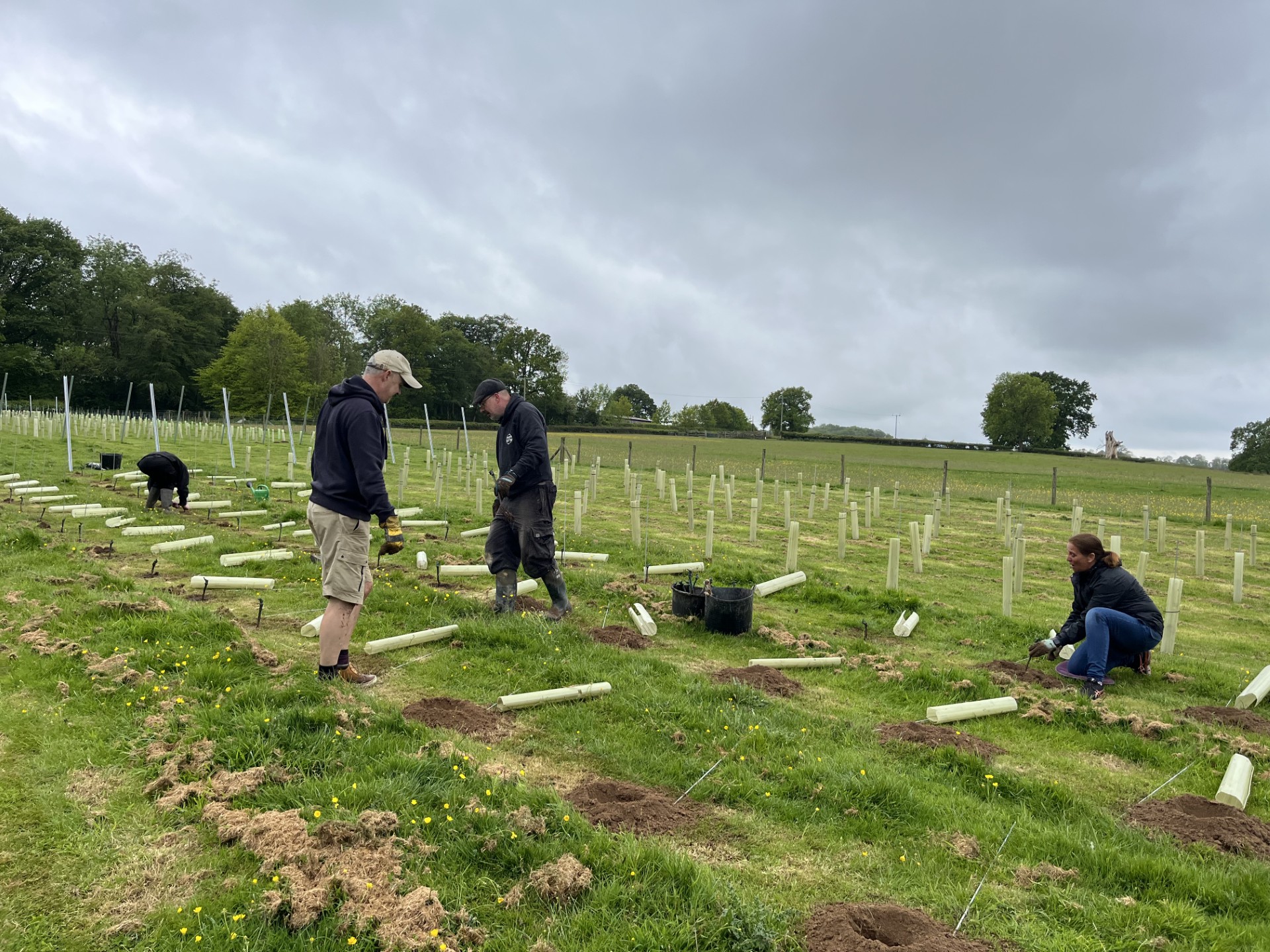
Once the vines arrived, we were keen to get them into the ground as quickly as possible to prevent the roots from drying out. Until planting could begin, they were stored in our cellar, which provided ideal conditions: cool, dark and damp.
We started cautiously, planting just one row of around 50 vines on the first day as we refined our technique and workflow. With the help of two friends, we increased the pace considerably and managed to plant around 200 vines the following day. Progress continued over the next week, although other commitments meant we could not dedicate every day to planting.
Despite the assistance, planting 1,200 vines by hand was a physically demanding and seemingly never-ending task. By the end of the week, our backs certainly felt the strain. While there was great satisfaction in establishing the vineyard ourselves, it is probably a job we would happily leave to professionals when it comes to planting the next field.
24 October 2026
Marking out where the vines will go
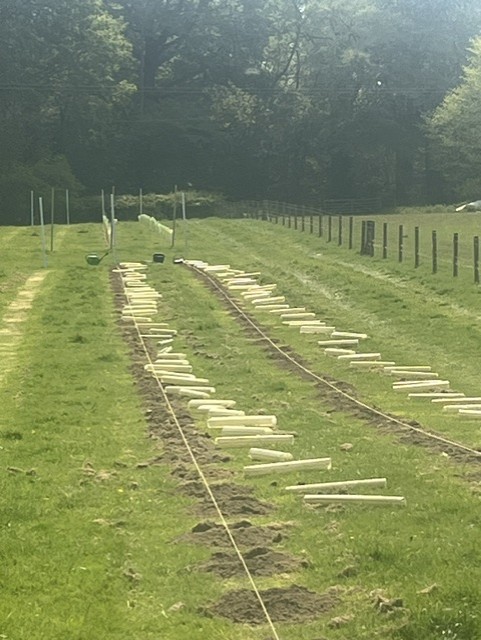
For our first planting, we decided to put all 1,200 vines into the ground by hand. This required careful planning to ensure every vine was planted in a straight line and at consistent spacing. Strings were stretched between the end posts to create accurate planting lines, while a simple wooden measuring board, cut to either 1.3 metres or 1.5 metres depending on the variety, was used to mark each vine position with spray paint.
One lesson was learned very quickly: the grass needs to be cut as short as possible before marking out the planting positions. On several rows, mowing after spraying removed much of the paint along with the grass, leaving us to remark sections before planting could continue.
Once the rows had been marked, we used a petrol-driven auger to drill a planting hole for each vine. This significantly reduced the physical effort of planting 1,200 vines by hand and ensured that each vine could be placed into a suitably sized hole. The auger proved invaluable in the planting process, particularly given the number of vines being established. The photograph shows the auger in use during planting.
24 October 2026
Preparing the field for the vines.
In November 2025, we carried out a soil analysis on the field earmarked for our first vine planting. The results recommended applications of lime together with phosphorus, potassium, magnesium, calcium, and boron. These nutrients were supplied in pellet form and intended to be spread across the site.
However, the persistently wet weather at the start of 2026 made it impossible to get machinery onto the field. As a result, we were unable to apply the amendments until early April. Fortunately, the quantity required was relatively modest, allowing us to use a small spreader attached to our sit-on lawnmower.
As part of our commitment to regenerative viticulture, we chose not to apply glyphosate to the grass strips where the vines would be planted. Whether this proves to be the best approach for newly established vines remains to be seen. Competition from grass and weeds may present challenges during the first few years, but we are keen to observe how the young vines perform within a more natural system.
24 October 2026
Before the vines! Knocking in the end posts.
At the end of April before planting the vines we needed to put the end posts in to the ground so we could work out where the vines were to be planted. There was 40 rows so 80 end posts needed to be knocked in manually (yes it was hard) using the knocker shown. Half way through the knocker top came off and we had to replace it. Ear protectors and a hard hat were essential for this job as you can tell by the video above. The weather was unusually baking hot (which meant the ground got harder as the day went on) and this took us several days. For our next planting field, next year we hope we can get the end posts in by a machine!
24 October 2026
Putting in a gripple anchor for the end posts
In July after planting all the vines by hand and knocking the end posts in. We needed to put in the fruit wires before we could do this we needed to anchor the end posts securely in the ground. We used the gripple system which as you can see from the video was much easier than knocking in the end posts.